Showing posts with label stitchwork. Show all posts

August 23, 2020

Girl In The Plasma Fields


Girl In The Plasma Fields, 2020,
hand-stitched cotton thread on vintage linen table cloth remnant,
25'' x 16''


“Stop acting so small. You are the universe in ecstatic motion”—Rumi 


Girl In The Plasma Fields started as a portrait of my teenage niece, referenced from a black and white photograph of her face. She hated the photo, but I thought it was beautiful, and that she looked very classical. I think the piece has an overall quality of antiquity about it. I stitched it by interlocking circle shapes together in what I call my modified chain stitch. I began it in mid-March, coincidentally around the same time that Seattle and Spain - where my niece lives -were each beginning their lockdowns due to the Covid-19 pandemic. When I worked on this piece I felt a synergy with her - even though we live so far apart - especially when I was stitching the face. She went through a long period of fear, when she would barely leave her room, and it was around the time that I started working on the background that she ventured back out into the world. It felt significant and synchronistic. 


This piece is about perception rather than transformation, about seeing ourselves as we are beyond our physical bodies. In addition to being a specific portrait, it's also a depiction of the luminous and unchanging presence underlying every person's particular story, and of the exquisitely tuned frequency of unified consciousness-the plasma fields - which create the manifest world. The images of the pinecone, the shell, and the Spanish moon moth act as both personal signifiers and mystical symbols. I associate the pinecone with the Fibonacci sequence that my niece learned about in school, and which is found consistently in nature. Here it also represents the sacred symbol of the esoteric third eye, or seat of the soul. I stitched it in purple threads to allude to the Violet Flame of the I Am presence. The shell denotes place and proximity to the sea, but it also has a liminal quality, representing an in-between state like that of existence during the quarantine. It contains the mystery and power of spiraling infinity, and I created it in colors that are very close to the rest of the background, as if newly formed out of the swirling energy surrounding it. I chose the wings of the Spanish moon moth, placed on the figure like a piece of clothing, to signify personal identity, while at the same time acting as a metaphor for the transience of the physical body and for the multidimensional reality of our human existence. 


April 12, 2020

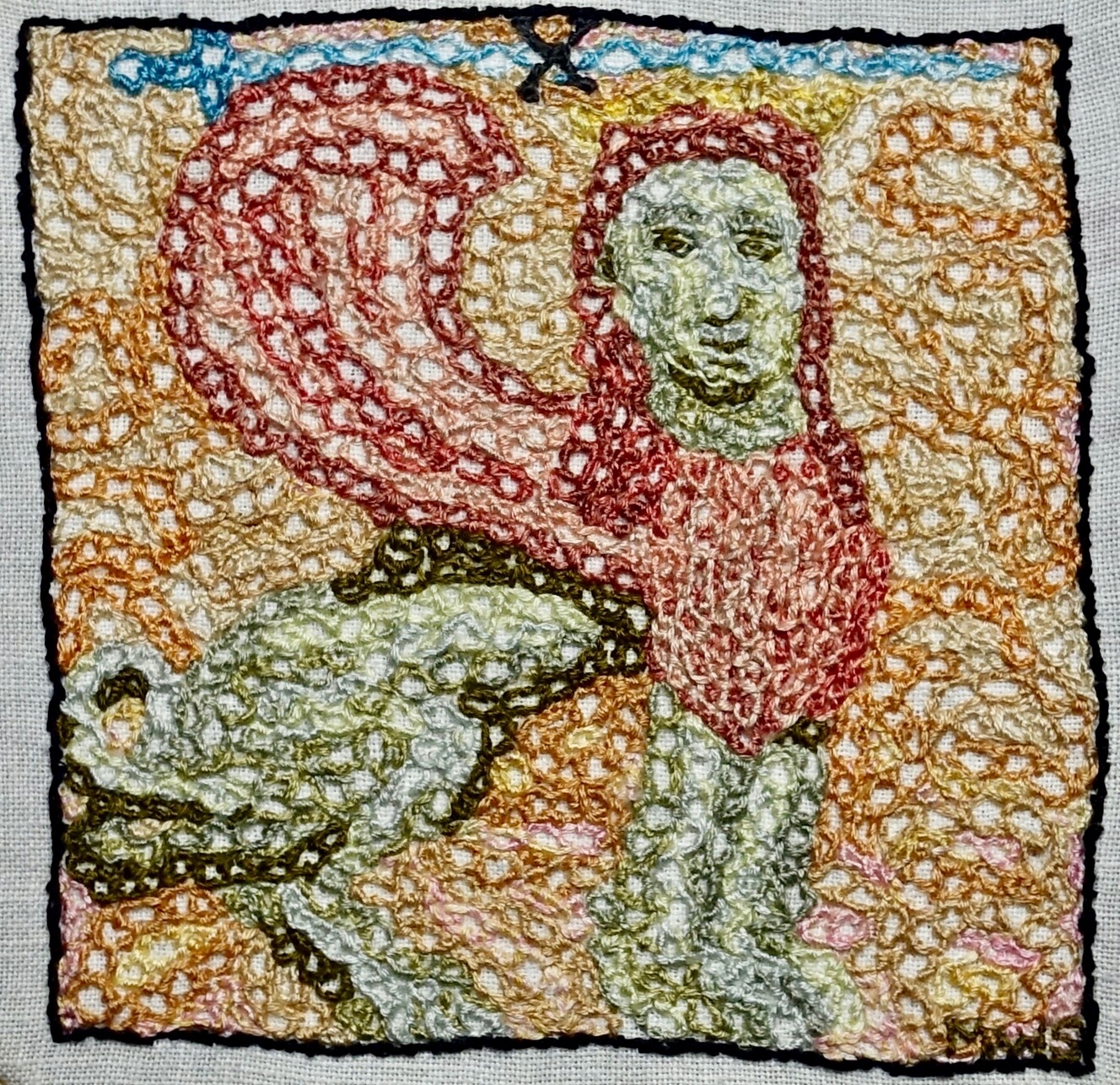
Outrageous Fortune


Outrageous Fortune, 2020,
hand-stitched cotton thread on linen, 
4.5"x4.5"

"Our true nature is divine and eternal. Our true purpose of life is to awaken and realize that permanent divinity that is within us.” 
― Amit Ray 


Outrageous Fortune is stitched in its entirety in what I think of as a modified chain stitch, and is inspired by the Sphinx creature on the top of the Wheel of Fortune tarot card. These figures are usually portrayed in the Egyptian version but this one is based on a Greek stone statue from the 6th century B.C. I added a crown on its head to represent divinity and a sword above it to symbolize the cutting away of delusions to discover who we actually are. I believe that this discovery is ultimately the greatest fortune of all. 


December 29, 2019

Rota Fortunae: Extant/Extinction

Rota Fortunae: Extant/Extinction, 2019,  hand-stitched cotton thread on linen, 9"x6" 


This is my last finished piece of 2019. The idea for it came to me in 2018 when I was researching the tarot for my piece 'The Queen of Wands Contemplates Saturn's Return' and I discovered The Wheel of Fortune (La Rove De Fortune) card from the Tarot De Marseilles deck, circa 16th century. On it are three fantastical and intriguing creatures that can represent luck or destiny, as well as the ever changing cycles we go through in life. The card has been modeled ever since the tarot's inception in the 15th century after the medieval concept of Rota Fortunae, the wheel of the goddess Fortuna. 

The theme of my version is the sixth extinction, and I stitched three different animal species and positioned them on the wheel according to their conservation status. On top is the Golden crowned kinglet, a bird that is thriving in population and also has a 'crown', reflecting the animal on the top of the Marseilles card. Going down on the left side is a critically endangered Red wolf, which is nearly extinct with fewer than 50 living in the wild. Heading back up on the right side of the wheel is an Island night lizard, which has made a dramatic comeback from its earlier endangered status. 


I made the spokes on the wheel into thermometers that surround a central earth to indicate the warming planet. The top of the piece has the words 'extant/ extinction' and I incorporated the card's number- Roman numeral X- into the word 'extinction'. I stitched these words in a similar color to the background so that you have to look carefully to see them. Many versions of the Wheel Of Fortune have a winged figure in each corner, and I placed wing-like shapes in this piece as part of the overall background design.


December 8, 2019

Fracking Paradise

'Fracking Paradise: Original Lies And The Temptation To Plunder', 2019, hand-stitched cotton thread on linen, 12'' x 16''


"The more clearly we can focus our attention on the wonders and realities of the universe about us, the less taste we shall have for destruction." -Rachel Carson 


My work, and this piece in particular, is very much informed by woven textiles, and I'm describing it as a needlework tapestry. While most of the figures and objects are rendered more or less naturalistically, I stitched the background with repeating stylized floral designs, and I filled in the land and sky with stitches that try to mimic weaving.

'Fracking Paradise: Original Lies And The Temptation To Plunder' is influenced by my maternal grandmother who understood the deep misogyny of the Adam and Eve myth and who read Rachel Carson's Silent Spring the year it was published. It's the culmination of my Fracking Weld County series, with visual ideas converging as a sort of contemplation on how we've gotten ourselves to the brink of creating an unlivable planet. The myth of Genesis is one of the stories that illustrates how we've become disconnected from both the natural world and our inner nature. The idea of eating from the tree of knowledge of good and evil points to duality and describes our separation from wholeness and the emergence of egoic identity stories that divide the world into parts to be conquered. The massive irony is that this narrative arose from the left-brained linear 'knowledge' of the patriarchal religious structure. It describes humanity's separation from the natural world by scapegoating the feminine, demonizing nature, and designating human sexuality ('man born of woman') as original sin. Without the dualistic view of the world, the tree and apples represent the abundance, generosity, and intelligence of nature. 

The central figures are taken from a 14th c Italian fresco by Bartoli di Fredi called 'The Creation of Eve'. I discovered the image in the book 'The Androgyne, Reconciliation of Male and Female' by Elemire Zola. Contrary to the title of the book, the idea that Eve is created from Adam's rib disempowers the feminine and reflects women's second class status as being merely adjunct human beings. I remember my grandmother asking, "if Eve came from Adam's rib, why aren't men missing one of their own ribs?".

Some of the images make compelling pairings of visual comparison and symbolic contrast. The first pairing of note is of the prehistoric goddess statue on the lower left (taken from the cover of The Chalice and the Blade, another book that my grandmother admired) and the oil rig carrying an exit sign on the far upper right. Another important pairing is of the serpent- which, rather than being the agent of deception from the Bible myth, here represents the universal Kundalini energy that is present in everything, connecting earth and cosmos- and the fracking pump, which represents the unsustainable and destructive extraction of fossil fuels, a form of energy that is inextricably linked to our current climate crisis. 

Other images include three critically endangered species: the Actinote zikani moth from the Amazon rain forest, a Brown mouse lemur, and a Pitcher plant. The lemur hangs on a fig tree near the sleeping (unconscious) Adam. Its leaves surround his head, foreshadowing the expulsion from paradise and the attendant shame that needs to be covered up. A plastic bottle lies on the ground, a surveillance camera points at Eve, and a small fighter jet hovers above the fracking equipment, close to a waxing crescent moon. The border is of a repeating ankh, bomb, and thermometer. 


Here are the words of Sandra Steingraber - biologist, poet, and environmental activist:

We are all musicians in a great human orchestra, and it is now time to play the Save The World Symphony. You are not required to play a solo, but you are required to know what instrument you hold and to play it as well as you can. You are required to find your place in the score. What we love we must protect. That's what love means. From the right to know and the duty to inquire flows the obligation to act. 


March 14, 2019

Miniature Fracking Blanket

Miniature Fracking Blanket, 2019 hand-stitched cotton thread on linen, 6" x 6"


"We are letting the extractive energy industries turn the world inside out." - Josh Fox

Although Miniature Fracking Blanket is a precursor to my work-in-progress series about fracking in Weld County, Colorado, it is mainly a stand-alone piece directly inspired by a woven Navajo blanket that was in my mother's family and that was recently sold (shown below). The story about who in the family purchased it - her father or grandfather - and in what year, got lost when she died. Her notes describe it as a Chief Blanket (third phase) 64”x 55”.

I thought about how the blanket ended up in my family. In doing some research I discovered a book titled Swept Under the Rug: a Hidden History of Navajo Weaving, by Kathy M’Closkey which explains the history of Navaho textiles in the context of colonization and economic exploitation. It includes an analysis of trader archives revealing that nearly all Navajo textiles were wholesaled by weight until the 1960s. M'Closkey explains how the Navaho artist’s weaving is "marginalized when the work is treated as a collectible craft and culture is split from commodity."


Miniature Fracking Blanket is a small piece, 6” x 6”, stitched in the mosaic style on a hoop. I wanted to create something in homage to the weaving’s beauty as textile art while at the same time acknowledging its context in the dominant culture. I replaced the central image in the blanket with a fracking/drilling rig to reference what is 'sacred' in a capitalist system that exploits the earth's resources for money. I chose this image in particular because the area that my mother's family is from, and where I grew up, is currently being subjected to extreme gas and oil extraction. 


I found this paragraph on a webpage of the Art Institute Chicago:

The Navajo believe that the deity Spider woman taught women how to weave and continues to work through today's artists by directing the growth and beauty of each textile they make. Finished blankets are thought to have life forces of their own, radiating a sense of vitality and harmony essential to the Navajo philosophy of hozho in which every individual strives to live in balance with the world.


February 10, 2019

The Queen Of Wands Contemplates Saturn's Return

The Queen Of Wands Contemplates Saturn's Return, 2019,
 hand-stitched cotton thread on machine-stitched
dish towel remnant, 15.5" x 12.5"


This piece is another of my 'dish towel tapestries', using the mosaic style combined with outline stitching. The idea for it had been brewing in my imagination for a while, but I couldn’t start it until the work for my solo show was finished. During the time I was working on the show I had a three card tarot reading which included the Queen of Wands. I don’t know much about tarot interpretations but I was immediately intrigued by the images on the card and I decided to create my own personalized version of it. The overall composition of The Queen Of Wands Contemplates Saturn's Return is influenced by classical paintings and mosaics, especially the central figure of the queen. I included the traditional symbols of the card: sunflower, black cat, wand, lions - and I added my own: pug, flicker, Saturn.

In the reading, I was told that the Queen Of Wands embodies creativity and living an unconventional life. Here she represents 'the self' - myself - and aspects of the higher self. Her crown is consciousness, its yellow reflected in the yellow of the large sunflower to her left which represents the soul. The stone pug, out of which the sunflower rises, replaces a stone lion in the original version and symbolizes my past and its seemingly concrete life story. The black cat is an obvious archetype of the shadow, or subconscious, and was the first thing that struck me about the card.  Both the wand, a branch with green leaves, and the bird perched on it, symbolize the earth and being grounded and inherently connected to it. I added the flicker in particular because I've often found symbolic meaning in my encounters with them. The planet Saturn represents our human relationship to the cosmos and, personally, its second astrological return. I stitched the two lions as part of the background, almost like clouds, to portray them as ethereal thought forms and emotions. They surround the queen as she takes a break from holding up her wand in one hand, and sunflower in the other, to reflect on her life in a moment of time.

September 30, 2018

Palestine Flip Map


I See Palestine Apart-Hide (This) Map, hand-stitched cotton thread, linen, 2018  21" x 16"


"Memory adds to the unrelieved intensity of Palestinian exile. Palestine is central to the cultures of Islam, Christianity, and Judaism...there is no forgetting it, no way of overlooking it."  -- Edward Said, from After The Last Sky: Palestinian Lives 


I created this map as an outsider and especially as an American whose government is directly complicit in the ethnic cleansing of Palestine; I don't claim to speak for Palestinians or to portray the Palestinian experience. As I've learned about Palestine and the false Zionist narrative that allows its Apartheid project to continue unabated, I've found that I can't look away. I refuse to not see Palestine or to dehumanize Palestinians. I refuse to be willfully ignorant about its erasure or complacent about the myth that it never existed. 

As Palestinian writer Nada Elia states, "the Zionist logic would also deny that Native Americans existed, because they did not have nation states recognisable to Europeans." 
In 1948, almost 80 percent of the Palestinian people had become refugees, an estimated 750,000 people expelled from their homes, their towns and villages, and hundreds were massacred. This is what is known as the Nakba, or catastrophe. 

My map depicts, on the right side, Palestine both before and after the Nakba, filled with images that I stitched in the 'mosaic style'. They include ancient mosaics and architecture, an olive tree, Jaffa oranges, fishing boats, a roundabout in Ramallah, the sculpture of a horse that stands in front of the Jenin Freedom Theater--that has been raided by Israeli soldiers numerous times--and the Al Aqsa Mosque, the third holiest site in Islam. I also represent the three major religions in the area of Jerusalem, and I did my best to be geographically correct with the placement of particular images that I chose. 

The map on the left side is not a real place but represents an ideology which is based on supremacism and separation, enforced by the machines of war that maintain Apartheid and colonization. Its shape is Palestine flipped backward to symbolize Zionism as devolution, and I stitched within it objects that include automatic weapons, a drone, fighter jets, bombs, a tank, a surveillance camera, the Apartheid wall, a helicopter, and a bulldozer.

The two map shapes together reminded me of a butterfly, and it came to represent the unseen collective soul that underlies the activities of human life. The right wing of the butterfly is outlined by olive leaves, the left by bullets, depicting things of the world that are either soul nurturing or soul killing.

I based the line design that fills the background on the Palestinian scarf called a keffiyeh, and it represents two things at once: the veil of forgetfulness that allows humans to be separated from their higher selves and to forget the oneness that connects us all, and the oneness itself, the unified whole where all of our lives are intertwined. I framed this piece with the keys that stand for the right of Palestinian refugees to return. The title has a dual meaning - I see Palestine apart -- hide (Apartheid) and hide this map (this map should be censored because it doesn't fit the mainstream narrative).


July 15, 2018

Tyche And Her Wheel

"Tyche And Her Wheel" 2018


"The slings and arrows of outrageous fortune"  from Shakespeare's Hamlet, 1603 

I stitched Tyche And Her Wheel in a modified mosaic style, using lines as well as square shapes. I was originally going to title this piece Fortuna And Her Wheel, but I changed it to the lesser known Greek version of the goddess. I also created my own idea of the wheel: it contains both the color scheme and images of vessels from ancient Greece, with depictions of a cornucopia, a hammer, a house, a bomb, a crutch, and a dollar sign. The image of Tyche is based on a figure in a French painting from 1605 by Thomas Artus.

Quoting E.S. Whittlesey from Symbols and Legends in Western Art, the goddess is shown with "a wheel as an emblem of chance, the turning of the year, the juggler of fortune... on some she heaped gifts from a horn of plenty, others she deprived of all they had; her overwhelming aspect was her uncertainty."

Although this piece is mainly influenced by Western mythology, its theme also relates to the wheel of Samsara from Eastern philosophy. In Buddhism, saṃsāra is the suffering-laden cycle of life, death, and rebirth, without beginning or end. It is often depicted as a circle divided like a pie into six realms.

I added other elements that represent both the impermanence and transcendence of mundane human experience: the goddess stands in front of the Tree of Life, holding an hour glass and preparing to spin her wheel, on which a bennu bird -an ancient Egyptian deity linked with the sun, creation, and rebirth - perches. This bird may have been the inspiration for the iconic phoenix that rises from the ashes, symbolizing resurrection and immortality.